Outcomes
Connect every course to the program it serves.
Course outcomes (COs) state what a learner can do by the end of one course, and connect each course to the program outcomes it helps develop.
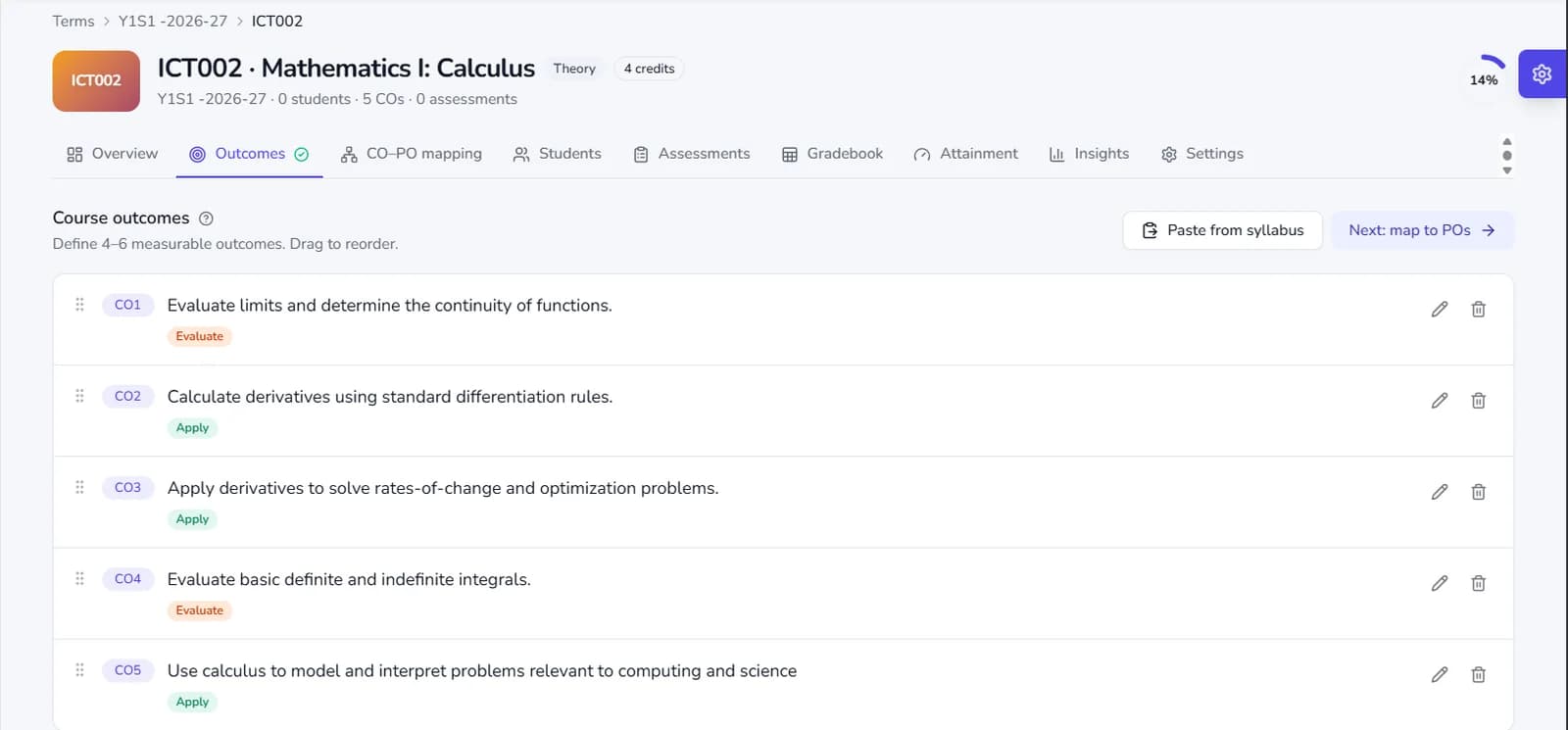
Writing course outcomes
Four to six outcomes, each tagged to a level
Good course outcomes follow the same rules as any learning outcome: one observable verb, a clear object and a scope that fits the course. Tagging each with a Bloom’s level makes the course’s cognitive demand visible at a glance.
In the CHED framework
Where course outcomes sit.

- Vision
- Mission

- PEO 1, PEO 2, PEO 3
- PO 1, PO 2 … PO nalso called PLOs

- Course A: CLO 1, CLO 2 … CLO n
- Course A: Assessment 1, Assessment 2 … Assessment nEvery assessment is tagged with COs and cognitive levels
Vision → PEOs → PLOs → CLOs → Assessment: every assessment maps to outcomes.

Adapted from the OBE workshop deck. Reference: CHED OBE framework. Labels vary slightly between program PSGs.
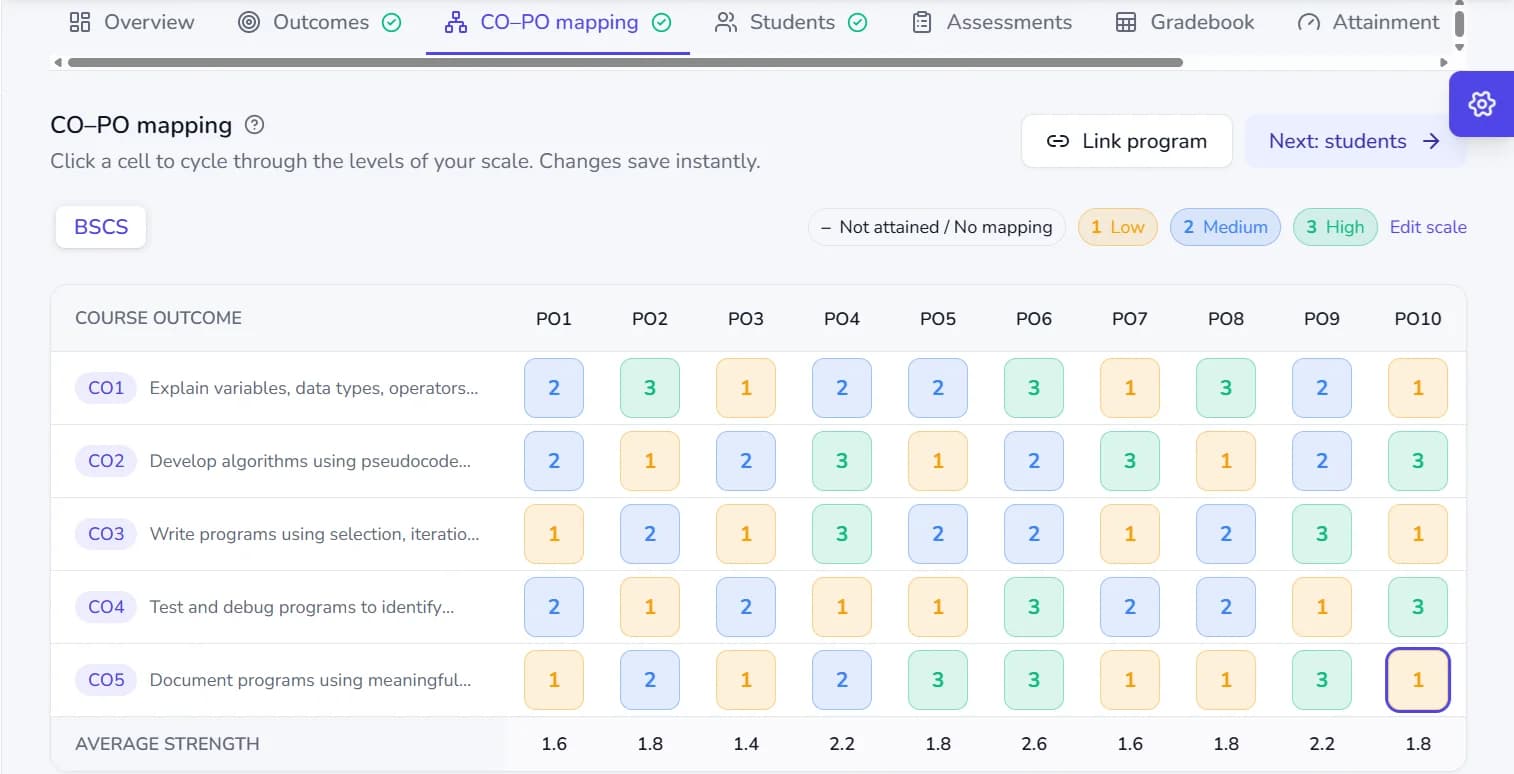
CO–PO alignment
Try a CO–PO mapping
| CO \ PO | PO1 | PO2 | PO3 | PO4 | PO5 |
|---|---|---|---|---|---|
| CO1 | |||||
| CO2 | |||||
| CO3 | |||||
| CO4 | |||||
| PO attain. | 2.67 | 2.50 | 1.40 | 2.50 | 3.00 |
- No mapping
- Low
- Medium
- High
Selected cell
CO1 → PO2
- Course outcome
- Analyze a small enterprise’s sales data.
- Program outcome
- Analyze complex problems
- Current rating
- High (3): the course outcome contributes substantially to this program outcome.
PO2 attainment
Σ(CO level × strength) ÷ Σ strength = (3×3 + 2×3) ÷ 6 = 2.50 on a 0–3 scale.
Sample CO levels: CO1 = 3, CO2 = 2, CO3 = 3, CO4 = 1. Data and method are illustrative.
3 High: the CO substantially develops the PO and is assessed for it.
2 Medium: the CO contributes moderately to the PO.
1 Low: the CO touches the PO only slightly.
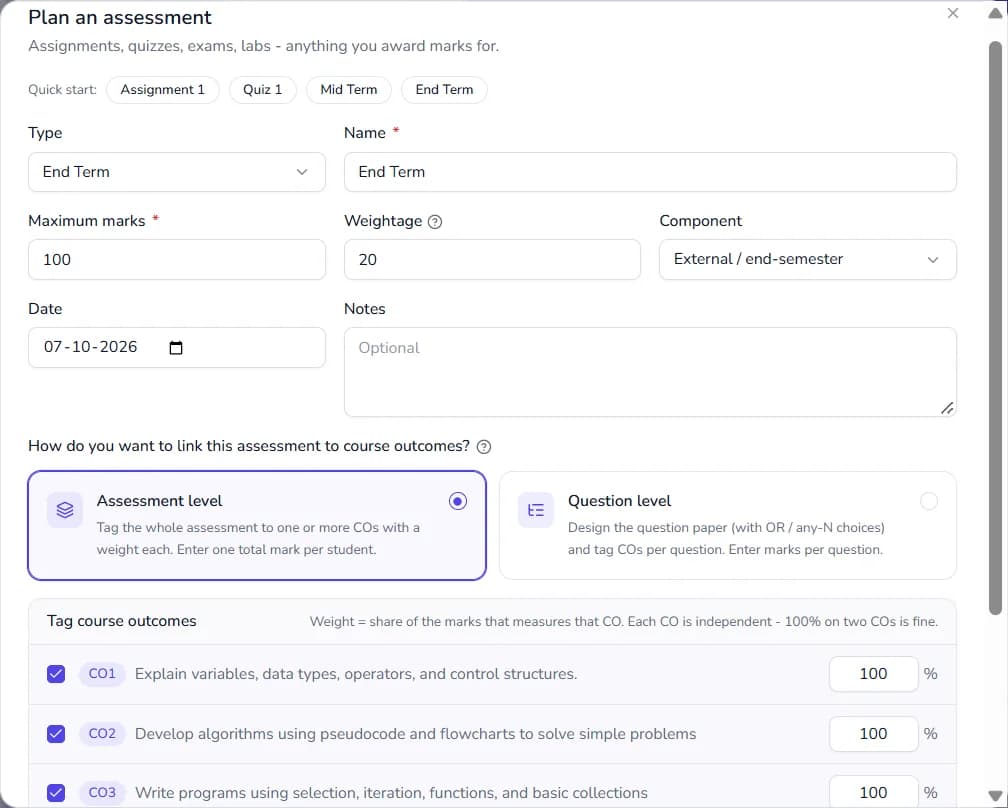
Assessment selection
Choose tasks that can show the outcome
Match the task to the level of the outcome. An exam alone rarely captures an outcome that asks learners to justify a decision or design a solution; an authentic task with clear success criteria usually does.
- Remember / Understand
- Quizzes, short explanations, concept maps
- Apply
- Problem sets, lab exercises, worked calculations
- Analyze / Evaluate
- Case analyses, data projects, decision briefs scored with a rubric
- Create
- Design projects, capstones, prototypes with a written rationale
See a worked example
Follow one outcome (analysing a small enterprise’s sales data) to its authentic task and success criteria.
Measurement and interpretation
Read the result, then ask why
Check whether the assessment really measured the outcome, whether marks were tagged to the right COs, and whether the threshold suits the level. Then decide on an action and record it.
Continue the guide
Turn this into practice today.
Map outcomes, plan assessments and see CO and PO attainment in OBE Studio. Free to start.