Outcomes
Write outcomes anyone can assess.
A learning outcome describes an observable performance: what a learner will be able to do, stated clearly enough that two assessors could agree whether it has been shown.
Anatomy
Three parts of a well-formed outcome
“By the end of the course, learners will be able to Analyze a small enterprise’s sales data and justify a recommendation.”
- 1. Action verb
- One observable performance
- 2. Content
- What the learner works on
- 3. Purpose or standard
- What makes it a complete capability
Example outcome adapted from the workshop case study in the supplied OBE presentation.
From outcome to evidence
One outcome. One authentic task.
- Intended outcome
ExampleAnalyze a small enterprise’s sales data and justify a recommendation.
- Assessment task
ExampleSubmit a cleaned spreadsheet, a short dashboard and a decision brief.
- Success criteriaExample
- Accurate analysis
- Reasoned recommendation
- Responsible data handling
- Clear explanation


A learner who meets these criteria has demonstrated a capability the course can report with confidence.
Workshop example from the OBE deck, not a prescribed CHED course.
Observable and measurable
Write the verb you can assess
The verb carries most of the meaning. Choose the cognitive level the course genuinely targets, then pick one verb from that level. Bloom’s taxonomy offers a shared vocabulary for doing this consistently.
Scope matters too. Most courses are well described by four to six outcomes: enough to cover the course, few enough to assess each one properly.
Observable
calculate · explain · analyze · design · justify · compare · construct
Hard to observe
know · understand · learn · appreciate · be familiar with
Before and after
Rewriting weak outcomes
| Before | After | Why it is better |
|---|---|---|
| Before | AfterAnalyze a small enterprise’s sales data and justify a recommendation. | Why it is better“Understand” cannot be observed; the revision names a performance and a product. |
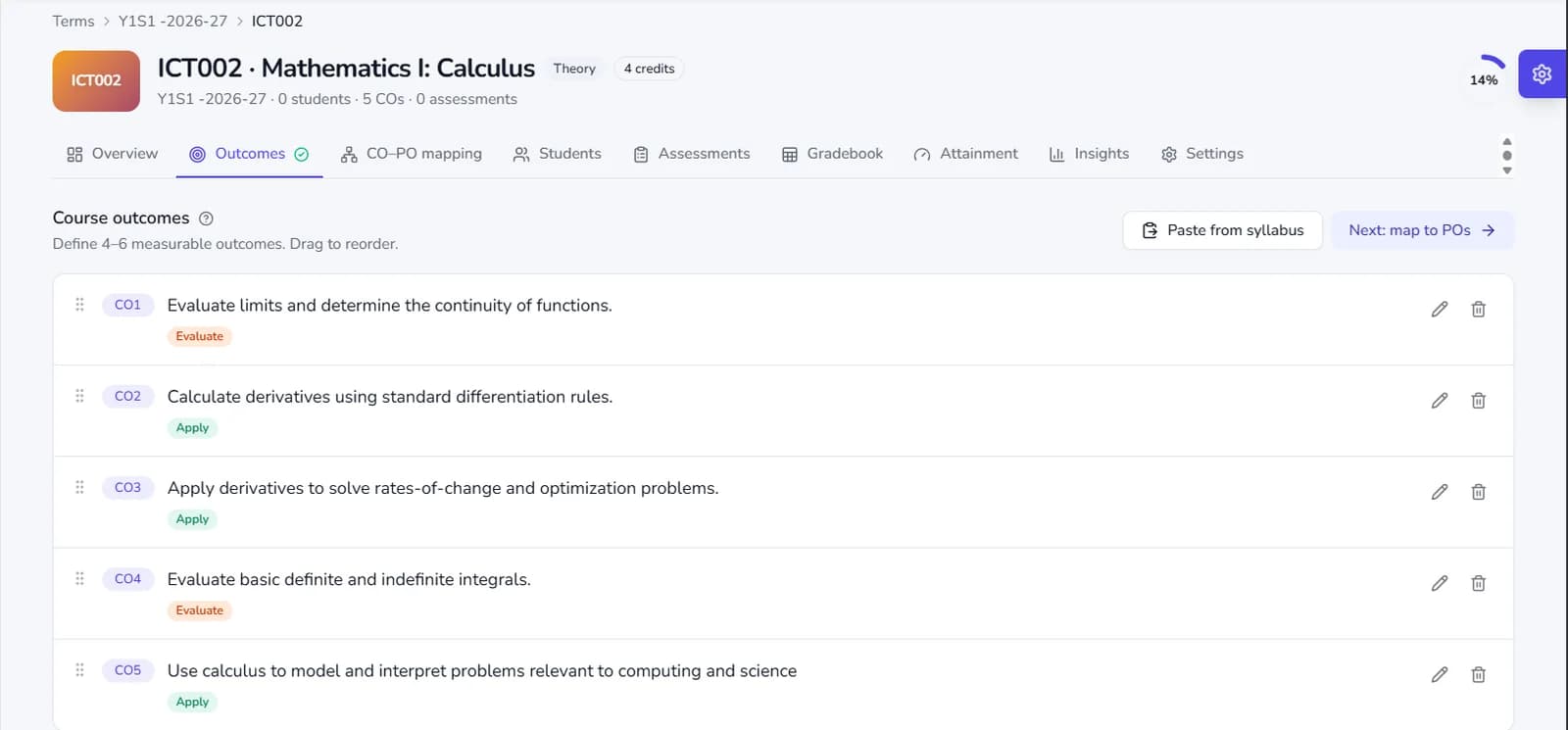
| Before | AfterCalculate derivatives using standard differentiation rules. | Why it is betterThe revision describes what the learner does with the rules. |
| Before | AfterDocument programs using meaningful names, comments and a short user guide. | Why it is betterAn attitude becomes a task an assessor can check. |
| Before | AfterEvaluate limits and determine the continuity of functions. | Why it is betterOne outcome, one capability. Split long topic lists into separate outcomes. |
Common mistakes
Five things to check before you finalise
Vague verbs
Know, understand, learn, appreciate and be aware of describe internal states. Choose a verb that names a visible performance.
Several outcomes in one
A sentence joined by many ‘and’s is hard to assess. If two parts could be achieved separately, write two outcomes.
Describing the teaching
“Students will be introduced to…” describes what the teacher does. Outcomes describe what the learner can do.
Wrong scope
A course outcome that could describe a whole degree is too broad; one that fits a single lesson is too narrow.
No evidence planned
If no task will show the outcome, it cannot be reported as attained. Plan the evidence as you write.
- Claim Free Access
Put it to work
Write your course outcomes in OBE Studio and tag each with its Bloom’s level.
Continue the guide
Turn this into practice today.
Map outcomes, plan assessments and see CO and PO attainment in OBE Studio. Free to start.