Understanding OBE
Every assessment, traced back to your mission.
Institutional intent cascades into program and course outcomes; assessment shows whether they are achieved, and the results drive improvement.
The outcome chain
Every assessment maps to an outcome. Every outcome maps to institutional intent.

- Vision
- Mission

- PEO 1, PEO 2, PEO 3
- PO 1, PO 2 … PO nalso called PLOs

- Course A: CLO 1, CLO 2 … CLO n
- Course A: Assessment 1, Assessment 2 … Assessment nEvery assessment is tagged with COs and cognitive levels
Vision → PEOs → PLOs → CLOs → Assessment: every assessment maps to outcomes.

Adapted from the OBE workshop deck. Reference: CHED OBE framework. Labels vary slightly between program PSGs.
Key terms
What each layer means
- InstitutionVision & mission
- The institution’s long-term direction and purpose, including the graduate attributes it commits to.
- ProgramPEOs
- Program educational objectives describe what graduates achieve a few years after graduation, where the program’s PSG uses them.
- ProgramPOs / PLOs
- Program outcomes describe the capabilities every graduate should demonstrate at graduation.
- ProgramPSOs
- Program-specific outcomes add discipline-specific capabilities to the common program outcomes, where used.
- CourseCOs / CLOs
- Course outcomes state what a learner can do by the end of a particular course.
- CourseAssessment
- Tasks and criteria that reveal learning. Each task is tagged to the course outcomes and cognitive levels it measures.
Not every program’s policies, standards and guidelines (PSG) use identical labels. Use the terms your program’s PSG and accrediting body specify.
Line of sight
A visible line from mission to assessed work.
- InstitutionMission and graduate attributes
- ProgramCapabilities expected at graduation
- CourseOutcomes the course develops
- AssessmentTasks and criteria that reveal learning

Program educational objectives describe later graduate achievements, where the PSG uses them.

Adapted from the OBE workshop deck. Reference: CHED OBE Handbook (2014).
Alignment
Outcomes cascade down; every course stays aligned
CHED’s 2014 OBE Handbook describes two movements. Outcomes flow from the institution to each program and then to each course. Within every course, the outcomes, the learning tasks and the assessments must agree with one another.
Map a course outcome to a program outcome only where the course genuinely develops it. Mapping everything to everything makes a matrix look complete but tells reviewers nothing.
Within one course
- Outcomes
- Learning tasks
- Assessment
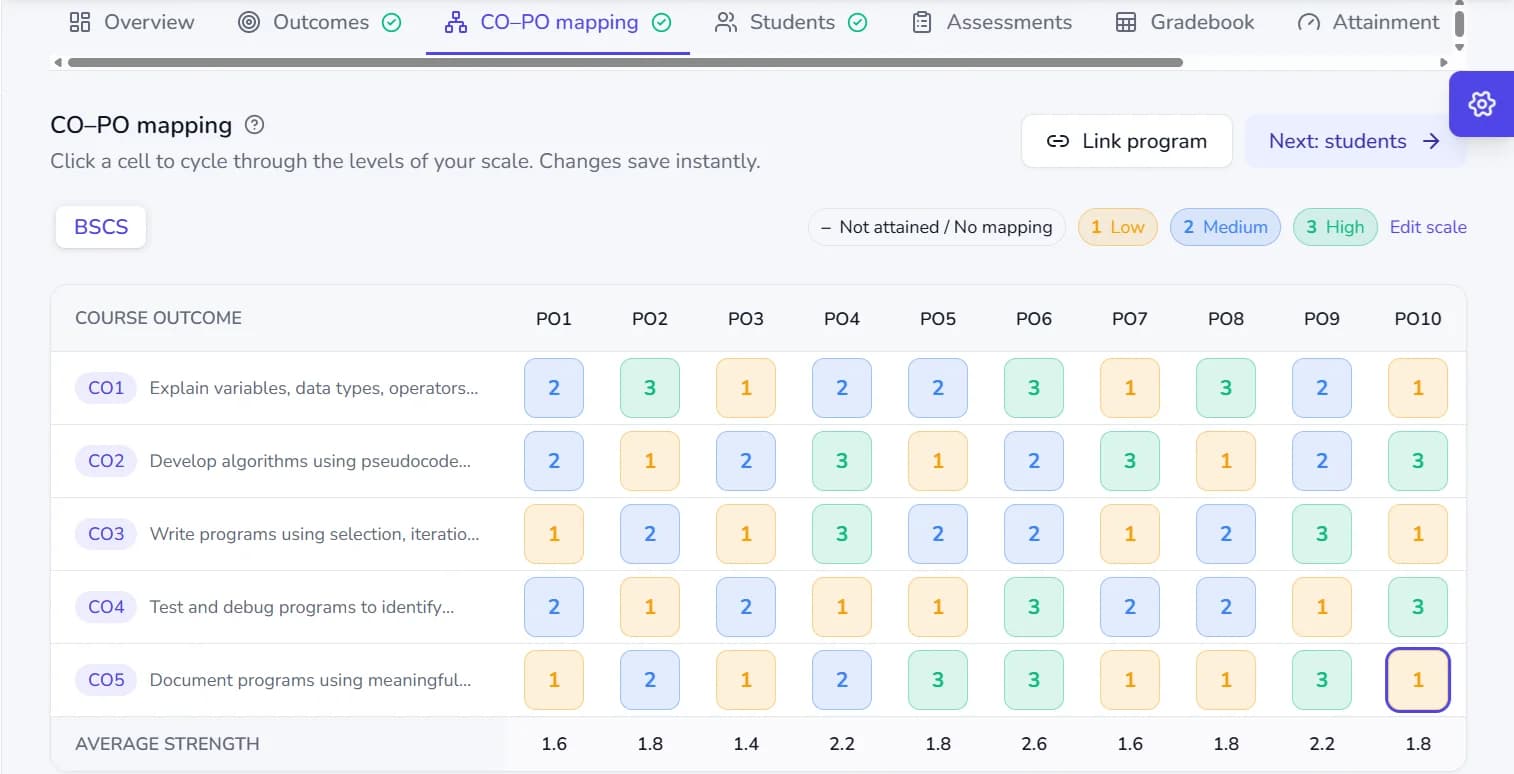
The framework in policy
CMO 37: promise outcomes, then prove them.
- 01Mission & visionSet direction
- 02Program objectivesSet direction
- 03Program outcomesDesign
- 04Curriculum mappingDesign
- 05Teaching & learningDeliver & check
- 06Assessment & evaluationDeliver & check
Evidence
One record. The whole story.

- Approved outcome and version
- Task, rubric and assessed work
- Result, feedback and improvement action

- Faculty can locate the learning gap.
- Chairs can compare patterns.
- Leaders can review the response.


A shared record reduces repeated compilation and supports academic judgement.

Adapted from the OBE workshop deck. Reference: CHED OBE Handbook (2014); recommended evidence record.
Continue the guide
Turn this into practice today.
Map outcomes, plan assessments and see CO and PO attainment in OBE Studio. Free to start.