A learning outcome describes an observable performance: what a learner will be able to do, stated clearly enough that two assessors could agree whether it has been shown. A well-formed outcome has three parts: an action verb, the content the learner works on, and the purpose or standard that makes it a complete capability.
“By the end of the course, learners will be able to analyze a small enterprise’s sales data and justify a recommendation.”
Before you finalise an outcome, run these five checks.
1. Is the verb observable?
Know, understand, learn, appreciate and be aware of describe internal states. Choose a verb that names a visible performance: calculate, explain, analyze, design, justify, compare, construct. Browse verbs by Bloom’s level.
2. Is it one outcome, not several?
A sentence joined by many ‘and’s is hard to assess. If two parts could be achieved separately, write two outcomes.
3. Does it describe the learner, not the teaching?
“Students will be introduced to…” describes what the teacher does. Outcomes describe what the learner can do.
4. Is the scope right?
A course outcome that could describe a whole degree is too broad; one that fits a single lesson is too narrow. Most courses are well described by four to six outcomes: enough to cover the course, few enough to assess each one properly.
5. Is the evidence planned?
If no task will show the outcome, it cannot be reported as attained. Plan the evidence as you write: one outcome, one authentic task, and the criteria that decide whether it was shown.
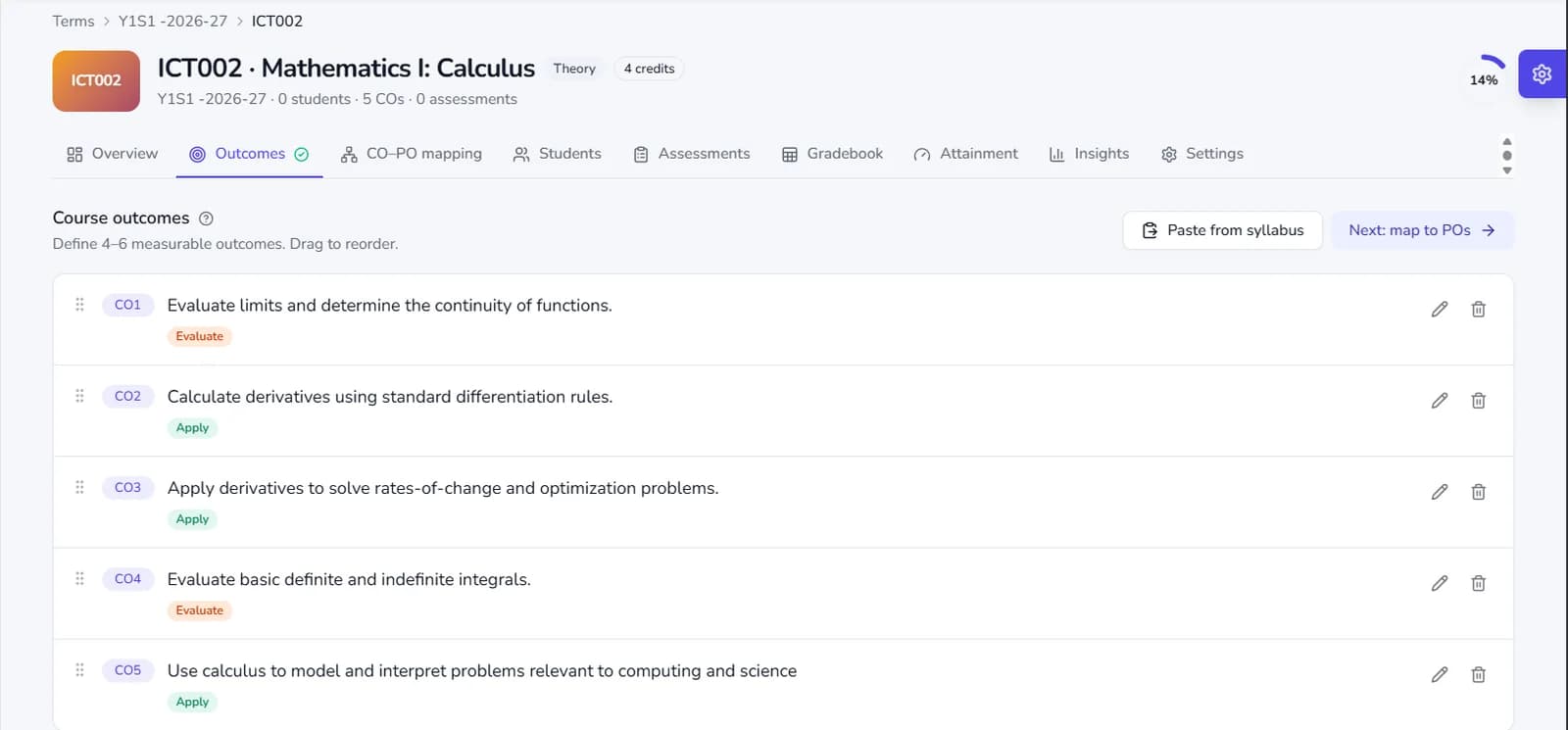
For before-and-after rewrites and an anatomy diagram, read the full guide: Writing learning outcomes.